Design-led is a phrase that's on every architect's website, including ours.
But if you’re thinking about commissioning a project and you’re trying to work out what it actually means for you, for your home, your budget, your experience of the process, it’s worth investigating further.
You’ve probably read it a hundred times
Design-led practice. Design-led approach. Design-led thinking. Search for an architect online and the phrase appears so often it starts to blur into the background. Which is a problem because behind it sits something genuinely important, and if you’re about to invest in a significant building project, you deserve to know what it means in practice.
The most obvious reading is that your architect cares about what things look like. And of course they do. But if that were all the phrase meant, every architect in the country would qualify. Caring about aesthetics isn’t a differentiator, it’s just the minimum requirement of the job.
So what is it really saying? And more importantly, what should you expect it to mean for your project?
It starts with your problem, not your architect’s ideas
Most people come to an architect with something already forming in their mind. A rear addition. A loft conversion. A new home on a plot they’ve just acquired. That instinct to arrive with a solution is completely natural, you’ve been living with the problem long enough to start solving it in your head.
But a genuinely design-led practice will ask you to set that solution aside, at least for a moment, and start somewhere different. They’ll want to understand how you actually live. What happens in your house on a Tuesday morning when everyone’s trying to leave at the same time? Where does the shopping go when you come back from the supermarket? How does light move through the building across the day? What does the house feel like in winter? What are you tolerating that you’ve just learned to live with?
These aren’t polite warm-up questions. They’re the beginning of the design process. Because the best outcomes, the projects that genuinely transform a home rather than just add square footage to it, almost always come from understanding what’s actually wrong before reaching for a solution.
Sometimes the answer is exactly what you imagined. But sometimes it isn’t. Sometimes the house needs reconfiguring, not extending. Sometimes taking something away unlocks more than adding something would. Sometimes the real problem is light, or circulation, or a section height that makes the main living space feel compressed and mean. A design-led practice finds those things. A drawing-production service just draws what you asked for.
What it means to work with us
When we say design-led at George & James, we mean that design thinking is present at every stage of your project, not just in the early concept work, but in how we manage your budget, how we brief your contractor, how we respond when something unexpected comes up on site.
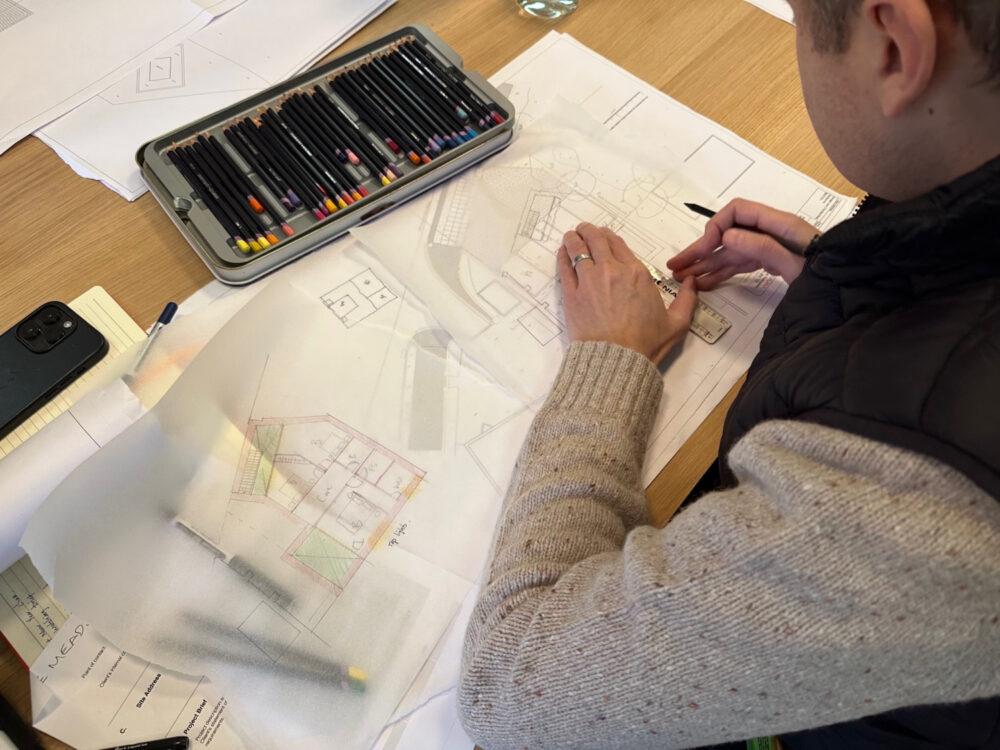
It means you’ll be asked questions before you’re shown drawings. It means we’ll tell you when we think the brief needs challenging, and we’ll explain why. It means the specialists we bring in are chosen because they’re right for your project, not because they’re the cheapest or most convenient. And it means that the drawings we produce, however polished, are the end of a process, not the beginning of one.
If you’re comparing practices and everyone says they’re design-led, the question worth asking is: what does your process look like before the drawing starts? The answer will tell you more than any portfolio.
If you have a project in mind, even if you’re not sure yet what the right answer looks like, come and talk to us. That’s exactly where the process should start. Start a conversation.

The work you won’t see, but will absolutely feel
Here’s something architects don’t say often enough: the most valuable parts of a design-led process are almost entirely invisible to you as a client.
You’ll see the drawings. You’ll see the planning application. You’ll see the finished building. What you won’t see is the conversation with the structural engineer at the point where a wall needed to come out, and the three options that were assessed before the right one was chosen. You won’t see the pre-application dialogue with the planning authority that shaped the proposal before it was ever formally submitted. You won’t see the decision about which specialist to bring in, and when, the ecologist, the heritage consultant, the party wall surveyor, or the coordination that keeps them all pointing in the same direction.
You won’t see the judgment calls: when to push for something ambitious and when to offer you a pragmatic option that delivers real value without unnecessary risk. When to produce a polished presentation and when a sketch across a table will serve you better. When the answer to a problem is more space, and when it isn’t.
None of this is what people mean when they imagine what an architect does. None of it photographs well. But all of it is design, and all of it affects how your project turns out.
Where you live matters as much as what you build
If your project is in a sensitive landscape, and many of ours are, in the South Downs National Park and across West Sussex and Surrey, then design-led means something additional and specific.
It means understanding the place well enough to know what it can absorb without losing something essential about its character. It means navigating planning policy not just as a set of constraints to comply with, but as a framework within which genuinely excellent architecture is still possible, sometimes because of the constraints, not in spite of them.
For you, that means a practice that knows the local context well enough to give you honest advice early, about what’s feasible, where the sensitivities lie, and how to position a project for the best possible outcome. That knowledge doesn’t come from searching planning databases. It comes from years of working in a place, building relationships with the people who make decisions in it, and understanding how good design and responsible stewardship of landscape can go hand in hand.
The goal every time is a building that feels like it genuinely belongs. Not one that shouts, and not one that apologises. One that someone might walk past years from now and stop for a moment, without quite knowing why, and think: that’s right. That works. Isn’t that something.
If you’re considering a project, we’d love to hear your ideas. Start a conversation.