Commercial realism, real data, and the decisions that keep a project on budget
Every client we work with is investing a significant sum in their home. Protecting that investment is not something we do at one point in the process. It is built into all of it, from the first conversation to the day the final certificate is issued.
We know what things cost, because we have measured them
In nearly ten years, and across more than two hundred projects, our team has built up something more useful than opinion. Between us we hold over 150 years of experience in this industry, but experience on its own is only memory. What we have alongside it is data.
On every full service project, we hold a measured quantity surveyor’s cost plan, at least three competitive tenders from vetted builders, and a signed contract sum. We keep all of it, and we average it. So when a client asks what something costs, we are not guessing, and we are not repeating somebody else’s rule of thumb. We can tell them what it cost, on projects like theirs, in this part of the country, recently.
That is what allows us to give advice that is occasionally uncomfortable, and to have what we think of as the real conversations. They are founded in evidence rather than optimism, and they are the most valuable thing we bring to a first meeting.
Early in the process, we align three things that have to be aligned: what you want, what is achievable, and what you are prepared to invest. When those three agree, everything afterwards becomes easier.”

Discover: ambition, meeting reality
Discover is where excitement and commercial reality are introduced to one another.
We review the brief, look hard at what the site will allow, and measure the whole thing against real costs. Not to dampen anything, but to align three things that have to be aligned: what you want, what is achievable, and what you are prepared to invest. When those three agree, everything afterwards becomes easier.
When they do not, the project is already in difficulty, whatever the drawings look like. A scheme that begins without a foundation of commercial realism does not usually fail quietly. It fails expensively, some way down the line, when the money runs out on a building site.
Design: serious about money, even while it is exciting
Design is where the strategy becomes architecture.
The brief and the site strategy from Discover are developed into a carefully considered design. Our clients are part of that evolution: we draw it, we model it in three dimensions, and we build on the possibility of a genuinely bespoke home. This is the exciting stuff, and it should be.
We are no less serious about money while it is happening. Every design decision carries a cost, and because of the data behind us we know what those costs are as the decisions are being made, rather than discovering them later. Choices about form, structure, glazing and material are all priced in our heads as we make them.
Towards the end of this stage, we recommend a quantity surveyor’s elemental cost plan, so the whole design can be tested thoroughly before we apply for planning or listed building consent. It is a real and worthwhile expense, and here is why we recommend it every time. There is very little value in holding a consent for a project that cannot be built for the money available.
Then the consent arrives, and the road forks and there are two routes.
Route one is chosen for entirely understandable reasons. The difficult part appears to be over, so the planning drawings go straight to a builder, who looks at them and offers a figure comfortably inside the budget. Work begins. Then the telephone calls start, each asking for a decision that has to be made immediately because a trade is waiting, and the invoices run higher than expected.
The thing nobody explained at the outset is that the figure was never a fixed price. It was an estimate. The builder was not being dishonest and could not have given a fixed price, because nobody had told them what they were being asked to build. The planning drawings showed the walls and the roof and said almost nothing about what was inside.
A lack of defined scope and information is the principal source of significant cost and time overruns on building projects. It is rarely bad luck, and it is rarely a bad builder. Roughly two in five renovation projects overrun, by an average of a fifth. The Get It Right Initiative, which studies error in UK construction, attributes around 21% of project cost to avoidable error, much of it rooted in design deficiencies and late design change. The Federation of Master Builders describes the same pattern from the contractor’s side of the table: budgets spiral not because the original price was wrong, but because of decisions taken once work has begun.
We do take calls from route one clients, but our ability to protect the money shrinks with every week that passes once building has started.
Route two spends the same money earlier, in a room where changing your mind is free.
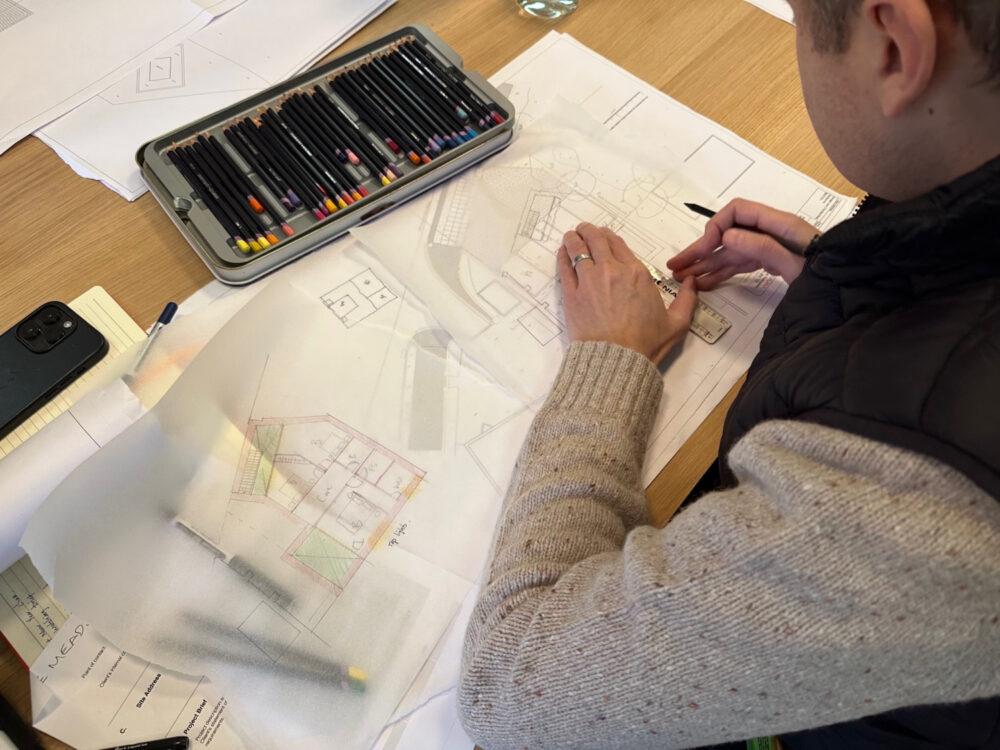
Detail is where the money is actually protected. It takes everything established in Discover and Design and turns the planning drawings into full technical construction information. Not only the structure, but everything within it. It is a substantial fee and we would rather say so plainly, because it is a thorough process requiring real technical expertise and a great deal of time.
There are around two hundred decisions to make. Written down that sounds daunting. In practice it is not, because you have time to consider things properly, and because nobody should feel overwhelmed by their own house. We guide clients through it in the right order, and every decision is tested against the cost plan as it is made.
A client brings us a tile. It is beautiful, and it is £150 a square metre. We agree that it is lovely, and then show them something similar at £75, which is what the cost plan allowed. They choose. The budget holds. Multiply that by two hundred, and you can see where cost control genuinely happens: not in a difficult conversation with a builder halfway through a build, but in a long series of small, calm, well informed choices made months before anyone arrives on site.
A complete set of information then unlocks the step everything depends on, which is a true competitive tender. The package goes to a small number of vetted builders who can price it accurately, because for the first time there is something accurate to price. They return a fixed price and a fixed programme. We evaluate the returns alongside our client and appoint the right contractor rather than simply the cheapest.
At that point the price is fixed and the programme is fixed. Only a genuine unknown, or a change of mind, can move either.
What that produces
We have been back through our own records to test this rather than assume it.
Every one of our last four projects was tendered below its cost plan, on average 13.8% below the figure the client had been working towards.
Across twelve completed projects, worth £7.7m of building work, the average difference between the contract sum agreed and the final account paid was 5.9%. Around three quarters of that movement was client variations: upgrades and changes of mind, chosen freely, once the house could be seen taking shape. Under a tenth related to design information.
On programme, five of our last eight projects reached practical completion on or before the date agreed. Four finished on the exact day. One finished a day early.
We guide clients through the process in the right order, and every decision is tested against the cost plan as it is made.”
Deliver: still protecting your investment
Once building starts we administer the contract, handle the communication, answer the builder’s questions and value the work. We certify what should be paid and when, against what has actually been built and to what standard. Our client is never the one deciding at speed on site.
One recent project shows what that is worth. As the build progressed, the contractor began submitting claims for additional payment on the basis that things had changed since they started. We were able to demonstrate, item by item, that the scope had not changed, and that everything they relied on was already contained in the Detail drawings and specifications they had priced. The claims were unsuccessful.
They were worth close to £80,000. Our fee for that stage was around £20,000. The client kept roughly £60,000 that would otherwise have left their account, and would have had no grounds to resist any of it had the information not existed.
We do not disappear when the builder finishes, either. The contract we administer runs on for a further twelve months, so the building can be tested through a full turn of the seasons. Money is held back across that period and released only once any defects have been returned to and put right.
The thread through our full service: architecture, interiors and project management
Most of what we have described only works because all three sit with one team.
We design the architecture and we design the interiors, the joinery, the lighting, the kitchen and the bathrooms, as one continuous idea rather than as separate purchases made months apart. That is why the specification can be complete enough to tender properly, and why the cost plan covers the whole house rather than the shell of it.
And then we manage the project. This is the part that most often sits outside a design appointment, and it is where a great deal of the money is protected. Running the tender, appointing the contractor, administering the contract, valuing the work and certifying what should be paid are not administrative extras. They are cost management, carried out week by week by people who designed the thing being built and can therefore tell, immediately, whether a claim is legitimate.
Investment planning and review is not one stage in our process. It runs through all of it, from the first exciting conversation to the final certificate. We are not afraid of the honest conversations, because they are founded in real data rather than emotion, and because they are what carries a client from a first idea to a home they love, with their money still where it should be.
If your consent has recently arrived, please do not go on alone. Talk to us about Detail and Deliver, and let us show you what your project should cost before anyone starts guessing. Book a call today.